


By Alice
▶ Table of Contents
GUESS WHAT?!
Mr. Fluffernutter and I just packed our explorer bags (mine has stickers and snacks… his has mysterious lint and exactly one sock), because we’re about to go on a Word Treasure Hunt!
You see, learning new words isn’t just school stuff. Nope. It’s basically like getting a golden key to a whole secret world. Every phrase is a puzzle piece. Every hello is a sparkly doorbell. And every language? It’s a new map God tucked into the corners of Earth, filled with hugs, flavors, and prayers that sound different but mean the same lovely things.
“Wait,” Fluffernutter said, with one ear flopped dramatically over his eye, “does ‘banyo’ mean I’m allowed to eat bathroom snacks?”
“Noooo,” I told him. “It means bathroom! You do NOT snack there, even in Spain OR the Philippines!”
(He looked suspiciously unconvinced.)
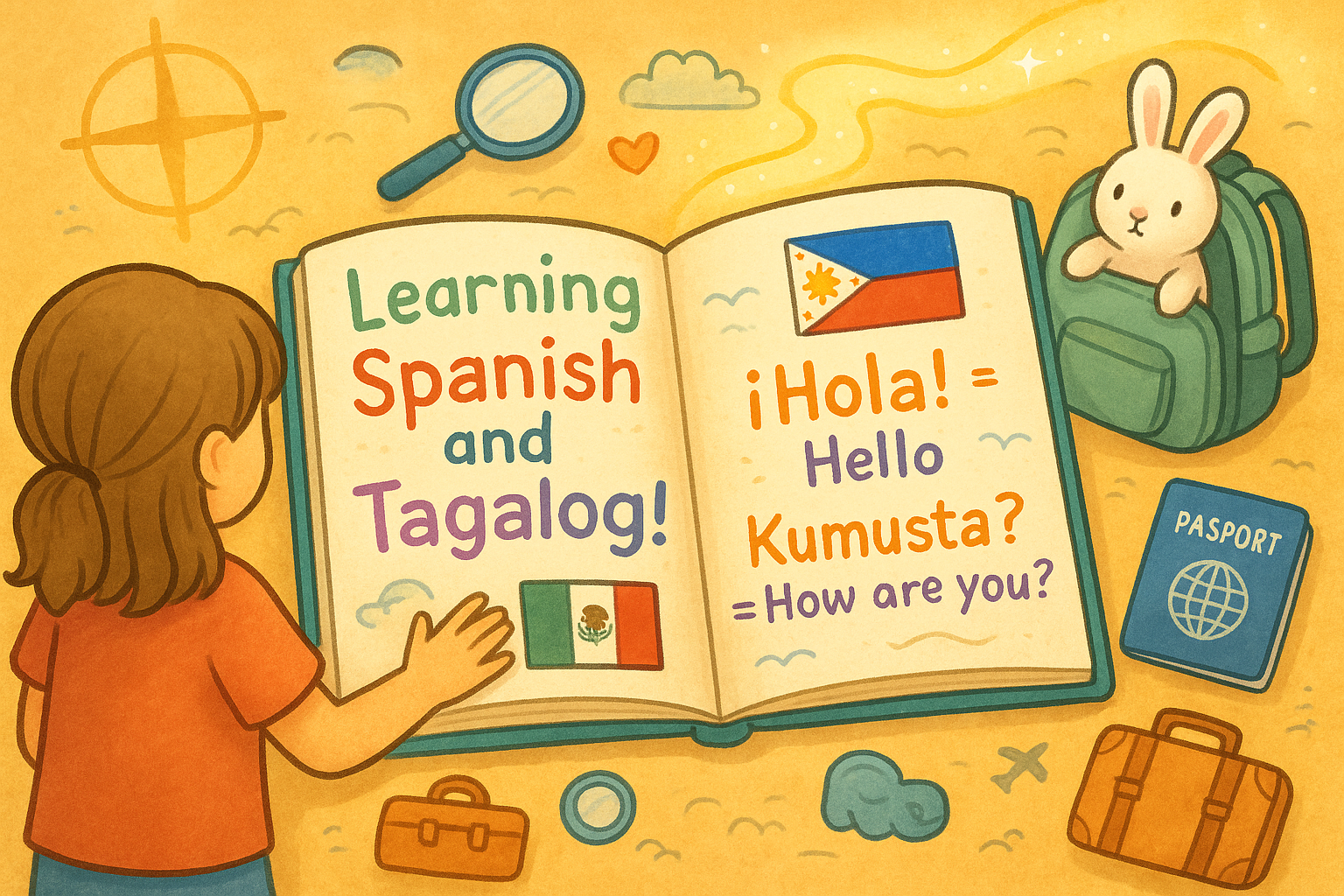
So today, I’m taking you on a magic-word adventure, right from our living room (aka Language Island). We’re going to learn Spanish and Tagalog, the sparkly, swirly languages spoken in places where the sun dances on mango trees and family means everything.

Grab the printable lesson pack: Learning Basic Vocabulary & Common Phrases (PDF)
Why both? Because our family is super-duper-extra-special. My mommy is Filipino, and lots of our friends speak Spanish. So when I say “Mahal kita” and “Te quiero,” it’s like my heart is learning to sing in two voices. And I think God loves that. I think He invented all the languages just so we’d have more ways to say “thank you,” “I love you,” and “You can’t eat my flashcards, Mr. Fluffernutter!”
✨ “Every tribe and language and people and nation.” — Revelation 5:9
That means YOU, me, your grandma, the kid who eats crackers too loudly at lunch, and the mailman. God hears us all. Even when we get our words wibbly-wobbly wrong.
So grab your pretend compass (or a banana—that’s what I used) and come learn a few magical phrases with me!
Next clue: starts with “¡Hola!” and rhymes with “koala.” 🐨
▶ TL;DR for grown-ups
Teach two starter languages side-by-side (Spanish + Tagalog) using 5 short steps: greetings, polite words, family & favorites, real-life mini-dialogues, and a “kindness + faith” closer. Use the PDF pack, practice aloud with call-and-response, and finish with a quick quiz and coloring page for memory.

📚✨ Why Learning Languages Is a Magical Adventure (According to Me, Alice!)
Okay, okay—Ariel says learning new languages is about “communication skills” and “global awareness,” but I say it’s basically wizard school for your mouth. 💬✨
When you start learning Spanish, Tagalog, or ANY of God’s giggle-spangled languages, it’s like stepping through an invisible wardrobe (yes, like Narnia, but with dictionaries). Suddenly, you’re not just you—you’re YOU… plus a word explorer with secret powers!
🧭 Meet New Friends from Magical Lands
Want to make a new bestie who lives across the world, eats mangoes on Tuesdays, and says “Mabuhay!” instead of “Hi”? Learn their words! Speaking Spanish or Tagalog is like building a rainbow bridge between your heart and theirs. 🌈
“Love your neighbor as yourself.” — Mark 12:31
Learning someone’s language is one way to love them better!
🎶 Understand Songs, Stories, and Super-Silly Movies
Ever heard a song that made you want to dance, but you didn’t know what it meant? That happened to me with a Tagalog lullaby once. I thought it was about mashed potatoes. (It wasn’t.)
Now, I can sing AND understand—and Fluffernutter hums along in dramatic bunny fashion. Language helps you unlock new songs, stories, and jokes that used to sound like gibberish but now feel like cozy bedtime tales.
🤫 Share Secret Family Codes
Imagine this: You and your family learn a few Tagalog words together. Next time you’re at the grocery store, you whisper “Gulay” (that’s veggies!) and everyone laughs like it’s a top-secret spy mission.
Language learning = family fun + code words + lots of giggles + maybe a veggie rebellion.
🌍 Become a Brave Explorer (Even in Pajamas!)
You don’t need a plane ticket to travel! When you learn phrases like ¿Dónde está el baño? or Salamat po, your imagination takes off like a rocket ship. 🧳 You feel ready to talk to market vendors, try new foods, or help someone who speaks another language.
🧠 Boost Your Brain (Like a Word Gym!)
Turns out, your brain LOVES new words like Fluffernutter loves carrot cake. 🥕 Studies say learning languages helps with memory, focus, and even problem solving. (I’m still working on solving the mystery of where my crayons disappear… but I feel smarter already!)
🌟 Family Chat Time!
- What’s a Bible verse you know in more than one language?
- What new word would YOU teach a friend in Spanish or Tagalog?
- Can you think of a time you used kind words to help someone feel welcome?

📝 What’s Inside Ariel’s Super Cool Paper? (Spoiler: A LOT of Awesome!)
GUYS. I peeked at Big Sister Ariel’s paper (with permission… kinda) and it’s SO packed with fun, it should come with a sparkly backpack and theme music. 🎒🎵
She didn’t just write words. She turned learning Spanish and Tagalog phrases for kids into a language treasure chest full of helpful clues, colorful giggles, and cultural surprises. Mr. Fluffernutter tried to eat the index page. He said it looked “alphabet-flavored.”
Let me show you what’s inside!
🚀 Must-Know Phrases (For Bathroom Breaks and Thank-Yous!)
Ariel started with the important stuff—like “Salamat po” (thank you) and “¿Dónde está el baño?” (where’s the bathroom?). Because let’s be real, if you’re going to learn a new language, step one is knowing where to find the toilet.
“Do to others as you would have them do to you.” — Luke 6:31
Saying thank you in someone’s language is like giving a smile with sprinkles on top. 🍩
🎨 Rainbow Words (AKA Colors + Counting!)
Did you know “pula” means red in Tagalog? I thought it was the name of a dragon! 🐉
You’ll learn how to count to ten and name your favorite colors—and maybe figure out what color your soul would be if it could dance. (Mine is glitter. Obviously.)
Learning these gives you language superpowers to describe, imagine, and maybe even paint words with your voice.
🛒 Snack-Time Sentences (Real-Life Conversations!)
Imagine ordering a quesadilla or a halo-halo in the actual language where it came from! 😋
Ariel shows how to ask for help, say your name, and talk about snacks (vital). These practical Spanish and Tagalog phrases help you feel brave in real situations—like making a new friend or asking for extra napkins without pointing awkwardly.
🎲 Fun Games and Bunny-Approved Activities
Learning doesn’t have to sit in a chair and wear glasses. It can hop, wiggle, and do scavenger hunts across the living room! 🏠📚
Ariel’s paper includes:
- A scavenger hunt with secret clues
- Story prompts where YOU write the ending
- A sing-along that made Fluffernutter twirl like a cinnamon bun
Games = memory magic. The more fun you have, the more your brain says, “YES! I shall remember that forever!”
📖 Celebrate Cultures Like a Curious Explorer
Words aren’t just sounds. They’re stories.
In Ariel’s research, she shows how different cultures use language to celebrate holidays, tell bedtime tales, and even explain the stars. When you learn someone’s words, you learn what makes their heart happy.
“Every nation, tribe, people and language, standing before the throne…” — Revelation 7:9
That means every language is invited to God’s big celebration!
🌟 Questions for Thought (a.k.a. Thinking Bubbles!)
- What holiday or tradition would you love to learn about in another language?
- Which phrase do you want to try saying today?
- Can you think of a time you felt excited to understand someone?

🧠 Smart Like a Superhero! (But With Flashcards and Snacks)
Did you know learning a new language gives your brain superpowers?
YUP. Like actual “cape flapping in the wind” powers. 🦸♀️ Except instead of flying, you get better at remembering things, solving tricky puzzles, and even doing math without crying. (Unless it’s fractions. Then we all cry a little.)
Mr. Fluffernutter tried learning “uno, dos, tres” but got distracted by a cookie crumb on page four. Still counts.
💪 Learning Languages Builds Brain Muscles
Every time you learn a new Spanish or Tagalog word, your brain goes sproing!—like it’s lifting a tiny vocabulary weight at the brain gym. 🧠🏋️♀️
“Whatever you do, work at it with all your heart, as working for the Lord.” — Colossians 3:23
That includes learning “kamusta” and “gracias”! Your brain is a gift—use it joyfully!
Scientists (and Ariel) say that learning another language helps you:
- Focus better (even when someone’s chewing loudly nearby)
- Switch between ideas faster (like hopping from Minecraft to math to dinner)
- Remember stuff longer (like where you put your left sock!)
- Become more creative (YES, even in your drawings of chicken pirates)

🌍 See the World Through Kind Eyes
When you understand how people speak, you also understand how they feel. That’s why Ariel says language learning builds empathy. 💖
You start to notice how words sound different, stories change, and emotions stretch across cultures like cozy blankets. Whether you’re saying “Te quiero” or “Mahal kita”, you’re practicing love—and God invented ALL the words, so every language is like a different sparkle in His big plan.
✈️ New Words = New Adventures
Know what’s better than being bilingual?
Being bunny-lingual! Just kidding. But really… when you know more than one language, you can:
- Travel with confidence
- Order your own ice cream in another country 🍦
- Understand people better
- Even become a translator (a real job!) or a missionary (a heavenly job!)
Plus, someday YOU might teach someone else. Maybe your little sibling, a friend, or even your pet cactus. (We don’t judge.)
🌟 Wonder Time for Families
- Can you think of a time when a kind word made you feel brave?
- What “brain superpower” have you noticed when you learn something new?
- Who would you want to talk to if you knew every language in the world?

🌟 Let’s Try It! (Bunny Challenge Activated!)
Okay language explorers… 🎺 DRUMROLL PLEASE…
I challenge YOU (yes, YOU reading this with cookie crumbs on your shirt) to learn three new words today!
Ready? Here’s the mission from me and Mr. Fluffernutter:
🎯 Pick one Spanish word, one Tagalog word, and…
- 🗣️ Use both in a sentence!
- 🐰 Bonus points if you say them dramatically to your pet, your pillow, or your big toe.
🧁 Here’s What I Tried:
- 📀 Spanish: “¡Hola, amigo!” (Hello, friend!)
- 📀 Tagalog: “Salamat po!” (Thank you, grown-up person!)
Then I turned it into a sentence:
“Hola, amigo! Want to share snacks? Salamat po for the cookies!” 🍪✨
(Fluffernutter nodded approvingly, even though he definitely stole the last cookie.)

✨ Bonus Mission for Super Learners!
Can you:
- Use your new Spanish and Tagalog words in a conversation at dinner?
- Create a mini skit or puppet show with your family using at least three phrases?
- Write a silly story using five words from Ariel’s super cool language list?
“Let your conversation be always full of grace…” — Colossians 4:6
That includes conversations with new words and funny bunny voices!
💬 Family Talk Time!
- Can you think of a kind word in any language that made your day better?
- Which new word made you giggle the most today?
- What was tricky about saying a new word out loud?

📚 Ready to Start Your Language Adventure? (With Snacks and Sparkles!)
Okay, okay—EVERYONE STOP WHAT YOU’RE DOING! 🛑
Because Ariel’s paper is officially AMAZING-SMART-SPARKLY-WOW and you get to read the whole thing! 🎉📖✨
She worked super hard (like, almost-missed-a-snack hard), and it’s filled with magical words, games, stories, and even secret language tricks. Mr. Fluffernutter says it smells like smart bunny paper.
🌍 What’s YOUR Favorite Word in Another Language?
I like “mahal” because it means love in Tagalog… and also because I say it every time I hug my stuffed animals.
“Dear children, let us not love with words or speech but with actions and in truth.” — 1 John 3:18
But learning how to say “I love you” in more than one language? That’s like giving your words wings.
✨ Every Word Is a Tiny Door to Wonder
Whether it’s “salamat” (thank you), “hola” (hello), or even “hygge” (cozy joy!), every word has a secret story. A feeling. A way of seeing the world.
Some words sparkle. Some whisper. Some dance like noodles in your mouth.
Learning them is like discovering a treasure chest that God planted inside someone else’s culture—and you just found the key!

🚀 Where Will Your Language Journey Go?
Maybe one day you’ll say “hello” in 10 languages. Or travel to a tiny café in a faraway land and order something delicious with confidence.
Maybe you’ll help someone feel welcome… just by knowing the right word. 💬🤝
Language learning isn’t just about saying things—it’s about loving people the way God loves: with our hearts wide open and our ears ready to listen.
Go read Ariel’s paper now—it’s packed with fun phrases, cool facts, and language adventures waiting to be discovered! ✍️📚
Then tell me YOUR favorite new word in the comments. Or whisper it to a banana. I won’t tell.
Love and language sprinkles,
Alice 🐰💬🌈
Explore More on B4A
Quick Quiz — Say It in Spanish & Tagalog!
Choose the best answer. Hit “Check Answers” to see your score. You can try again!
Spanish vs. Tagalog (with English)
| English | Spanish | Tagalog |
|---|---|---|
| Hello | Hola | Kumusta? |
| Please | Por favor | Pakiusap / Paki- |
| Thank you | Gracias | Salamat |
| Yes / No | Sí / No | Oo / Hindi |
| My name is ___ | Me llamo ___ | Ang pangalan ko ay ___ |
| How much? | ¿Cuánto cuesta? | Magkano? |
| Where is the bathroom? | ¿Dónde está el baño? | Nasan ang banyo? |
| Excuse me / Sorry | Perdón / Disculpa | Pasensya / Paumanhin |
| God bless you | Dios te bendiga | Pagpalain ka ng Diyos |
Vocabulary Table
| Term | Kid-Friendly Definition |
|---|---|
| Cognate | Two words in different languages that look or sound alike and mean the same thing. |
| Phoneme | A tiny sound piece in a word. Changing it can change the word. |
| Syllable | A beat in a word (like claps in a rhythm). |
| Stress | The part of a word you say a little stronger. |
| Loanword | A word borrowed from another language (Tagalog has many from Spanish!). |
| Polite particle | Small word that shows respect (Tagalog: po, opo). |
| Gendered nouns | Spanish nouns can be masculine or feminine (el/la). |
| Conjugation | Changing a verb to match who’s doing it and when. |
| Code-switching | Mixing two languages while talking—totally normal in bilingual homes. |


References & Resources
| Title | Type | Link | Notes |
|---|---|---|---|
| Learning Basic Vocabulary & Common Phrases in Spanish and Tagalog | Download | Primary printable used in this lesson. | |
| Featured Image | Image | Open | OG/Twitter card. |
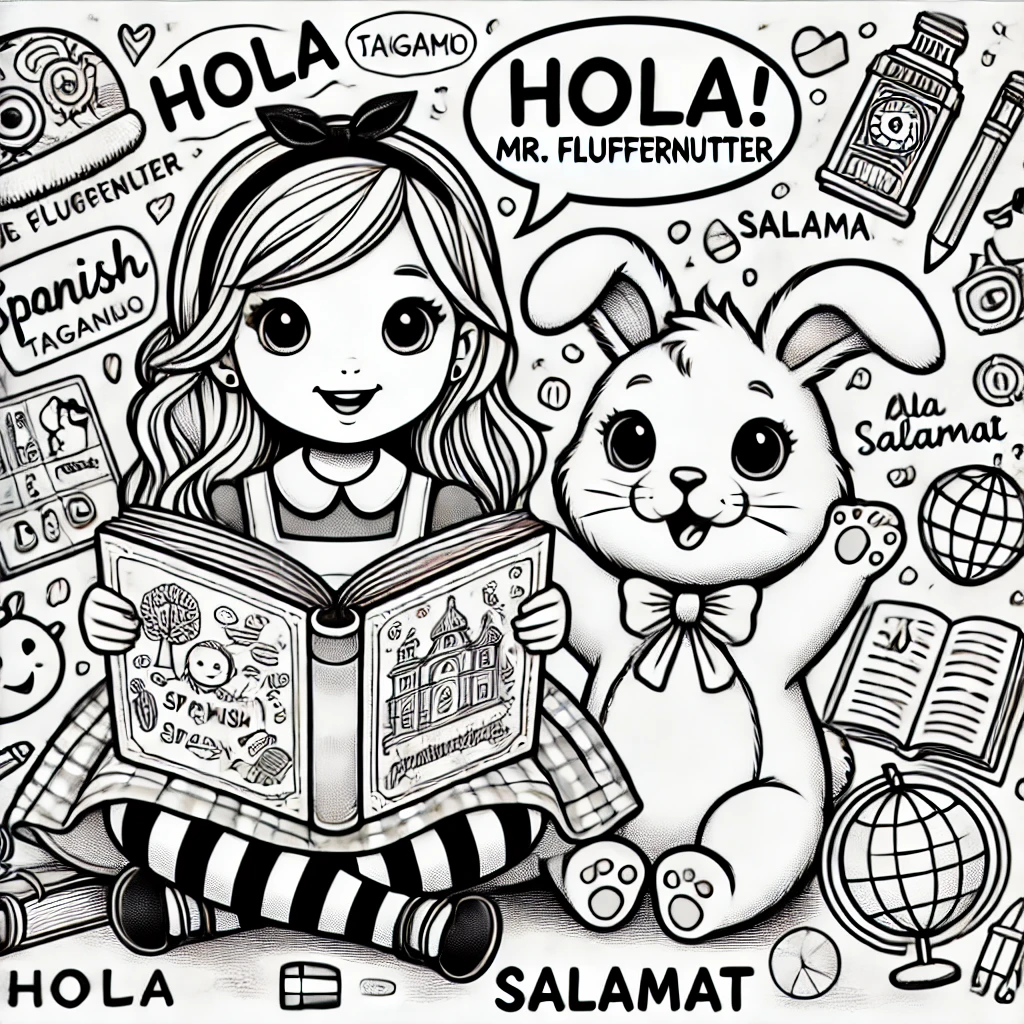
| Coloring Page | Image | Open | Memory lock-in after practice. |
| Educational Data Worksheet | Worksheet | Open | Optional extension activity. |

Quick Recap
- Start kind: greetings + please/thanks.
- Introduce names, family, and favorites.
- Run 2-line mini-dialogues, then swap roles.
- Play echo games to boost repetition with smiles.
- Close with a short faith reflection and a goal phrase for the week.

About the Kid Author
Alice writes whimsical, faith-friendly posts for kids on Blogging4Adventure. Favorite things: sticker charts, unicorn notebooks, and practicing kind phrases in Spanish and Tagalog with Mr. Fluffernutter. E-E-A-T: real homeschool practice, reproducible printables, and collaborative lessons with big sister Ariel.
Frequently Asked Questions
▶ How long should a session be?
10–15 minutes, 3–5 times per week. Short, consistent, playful.
▶ Should we mix Spanish and Tagalog in the same day?
Yes—use side-by-side pairs for high-frequency phrases, then rotate which language leads.
▶ Any quick pronunciation help?
Clap syllables, exaggerate stress, and use echo reading: adult says, kids repeat together, then solo.
▶ How do we keep shy kids engaged?
Props, whisper voices, and “teacher says” call-and-response—no cold calling.
[…] Spanish & Tagalog for Kids — check who made a list or worksheet. […]
[…] Spanish & Tagalog for Kids […]
[…] Spanish & Tagalog for Kids (geography + language) […]
[…] Spanish & Tagalog for Kids (greetings & respect) […]