


By Alice
Okay so—I THOUGHT WORMS WERE JUST SPAGHETTI WITH BAD MANNERS.
But apparently… they’re kind of the squishy heroes of the garden?
(Also, no—they don’t wear pajamas. I asked Fluffernutter. He said they “prefer to sleep in soil snugglers.” That means mud. Ew.)
Anyway, guess what happened?
🌟 My big sister Ariel turned into the QUEEN OF ECOSYSTEMS.
She didn’t even need a crown—just a magnifying glass and a VERY serious science face.
She taught me that ecosystems are like secret parties happening under our feet. With bugs. And dirt. And teamwork. (But no cupcakes, sadly.)
So I grabbed Fluffernutter, a magnifying spoon (normal spoons work too), and I yelled:
“WE SHALL DISCOVER THE WIGGLY TRUTH!”
Then we dug in. Literally.
Use this guided worksheet during your backyard or classroom investigation.
Extras: Data worksheet image · Coloring page
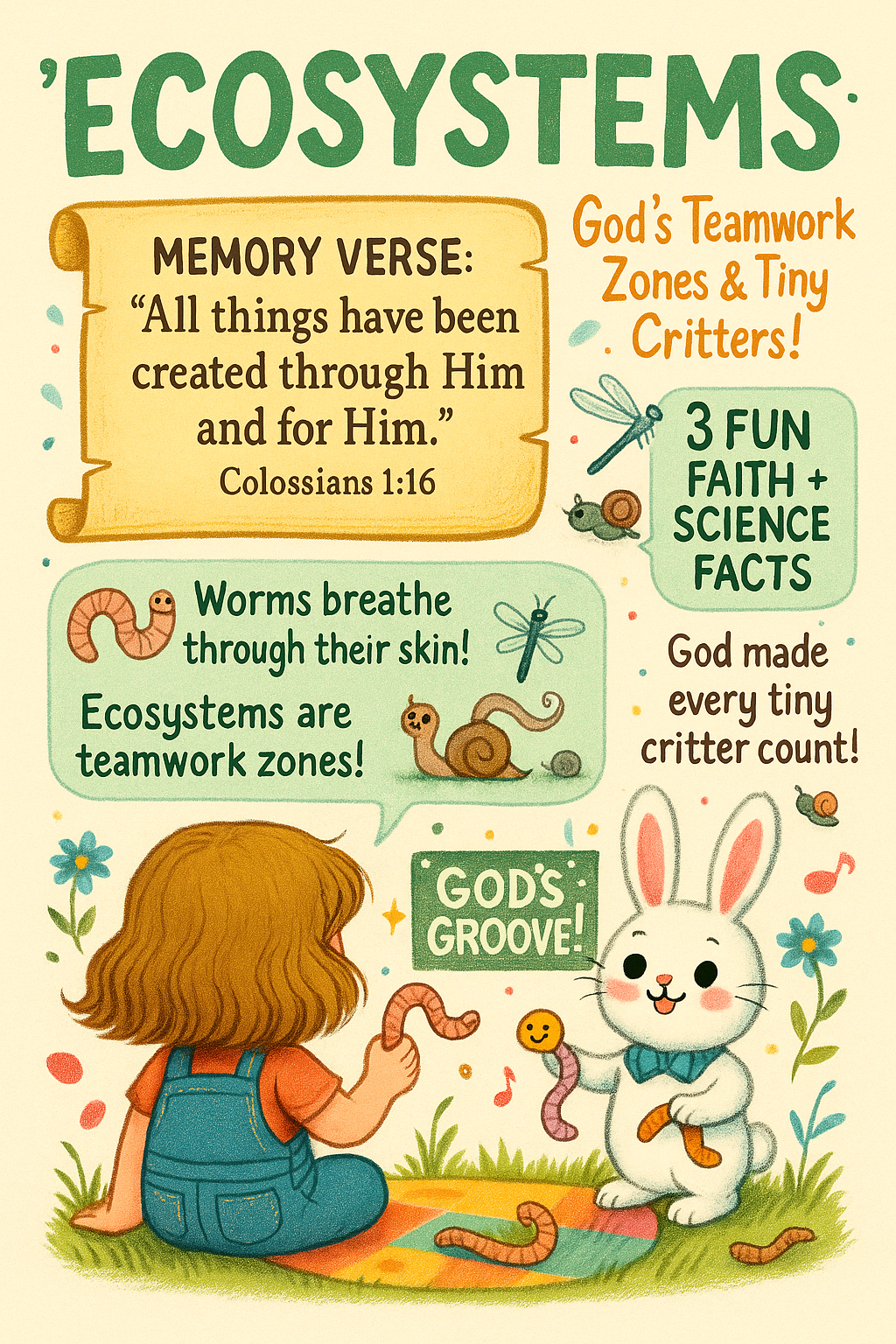
We found wiggly worms doing jobs. Like, ACTUAL JOBS. One was tilling soil. One was compost-crunching. One winked at me (probably).
And that’s when I realized: God didn’t make worms as yucky jokes—He made them important.
📖 “The Lord God formed man from the dust of the ground…” —Genesis 2:7
So I guess worms are like little dusty helpers? Tiny soil dancers for Jesus?
So if you’re ready to enter a garden where worms are warriors, Ariel is a science queen, and Fluffernutter gives unsolicited worm advice…
Then LET THE ADVENTURE BEGIN.
▸TL;DR — One-Minute Answer

🧪 Ariel Knows EVERYTHING About Ecosystems
So, Ariel wrote this brilliant, sparkly, brain-blowing science paper all about how ecosystems work.
(Which basically means she’s now the Official Queen of Dirt and Leafy Secrets.)
She explained three important groups:
They make their own food using light and science magic. (Also called photosynthesis, which I tried to say but sneezed out my gum.)
They eat plants. Or other chompers. Or both. (LOOKING AT YOU, FROGS.)
Like moldy bananas and helpful bacteria.
(Full honesty: I screamed once when I saw a banana with fuzzy pants.)
💬 “God made everything with a job—even the squishy stuff.” — Alice’s Science Brain (and Fluffernutter agrees)
Ariel even drew arrows showing how food moves through an ecosystem, which I now call “The Great Circle of Snacks.”
📖 “By Him all things were created… all things were created through Him and for Him.” —Colossians 1:16
Even compost! Even mushrooms! Even banana peels that look suspiciously like octopus ghosts!
- Have you ever learned something super weird that turned out to be important?
- Did you ever thank God for making invisible helpers like bacteria?
- What job do you think a worm would have on God’s garden team?

🐰 Mission: Magical Forest Ecosystem Adventure (In Our Living Room!)
To celebrate Ariel’s EPICALLY SMART paper about ecosystems, Mr. Fluffernutter and I launched an official adventure…
(Yes. Inside the house. Mommy said we had ten minutes and “no real worms allowed.”)
So, obviously, we built it with important ecosystem components like:
✨ One unicorn pillow = our producer
Why? Because it sparkled like sunlight and looked like it could photosynthesize glitter.
🪱 Three gummy worms = our consumers
They were very busy doing worm stuff until… I accidentally ate two. (I was scientifically peckish.)
🧦 One dirty sock from under the couch = our decomposer
Fluffernutter declared, “It smells like ancient compost!” and I agreed, while holding my nose.
I even made a food chain using pipe cleaners, stickers, and leftover goldfish crackers.
But then I became the top predator… because I got snacky.
RIP to the gummy worms. 🍬💀
💬 “Every creature has a part to play—unless they get eaten by a science princess.” — Fluffernutter
📖 “The earth is the Lord’s, and everything in it.” —Psalm 24:1
Even living room ecosystems. Even sock-based science. Even gummy worm sacrifices.
- Have you ever made your own mini ecosystem using stuff around the house?
- What role would YOU be in a food chain—producer, consumer, decomposer… or snack thief?
- Why do you think God designed nature to work like teamwork?

🌮 The Tale of the Trophic Tacos (a Tragedy in Three Layers)
So apparently, energy in an ecosystem doesn’t just zoom around randomly like a squirrel on a pogo stick.
Ariel said it moves through something called “trophic levels.”
Which I immediately renamed: TROPHIC TACOS.
Because why not?
🌮 Tacos = layers
🌿 Ecosystems = layers
✨ SCIENCE = delicious if you believe hard enough.
Here’s how Ariel explained it:
These are the producers—plants that soak up sunlight and make food. (Lettuce counts if you squint.)
He’s a primary consumer, because bunnies love to munch on plants. (And important documents. And shoelaces.)
I’m the secondary consumer and the Ultimate Taco Queen, because I eat both lettuce and bunny-shaped marshmallows. For science.
💬 “Ecosystems are like taco towers. Everyone gets a layer. Except sometimes the cheese falls off.” — Alice
📖 “Man shall not live by bread alone…” —Matthew 4:4
But I think tacos might be allowed if they’re educational?
So I made a beautiful trophic taco tower to celebrate this energy-transfering ecosystem fiesta.
And then—I tripped.
And then—Fluffernutter sat on it.
Now it’s a flat taco of sadness. 🌮💔
- If your family was a food chain, who would be the lettuce? The chompers? The snack-stealers?
- How do you think God designed energy to be shared between plants, animals, and people?
- Have you ever built something amazing and accidentally squashed it? What did you learn?

🍄 Shocking Fact Alert: Mushrooms Are FUNGUS (Not Pizza Toppings?!)
So guess what?
MUSHROOMS ARE FUNGUS.
Like… actual decomposers.
Like… the secret agents of the ecosystem.
Like… they live to rot things.
(Ariel told me this while eating string cheese very calmly. I had a full-body science panic.)
She said mushrooms are decomposers, which means they break down old stuff and return nutrients to the soil.
So basically—they’re recyclers from Planet Spore.
Naturally, I screamed:
“WAIT… I ATE ONE LAST NIGHT!!!”
Then I screamed again. And again.
Three full minutes of dramatic mushroom regret.
Fluffernutter patted my head and said,
💬 “Don’t worry. You didn’t turn into a tree. Yet.”
📖 “To everything there is a season… a time to plant and a time to uproot.” —Ecclesiastes 3:1-2
Maybe even a time to scream about salad toppings?
Mushrooms might look like umbrellas for ants, but they’re actually one of God’s weirdest, wildest helpers.
They take old, broken things and turn them into something brand new.
So… maybe they do belong on pizza. Or at least in science class.
- Did you know mushrooms are part of God’s clean-up crew?
- Can you think of other things that help restore and renew, just like God does in our lives?
- Have you ever been surprised to learn something that seemed “gross” was actually really important?

🌍 Save the Planet, Save the Gummy Worms! (And Also the Fruit Snacks)
Ariel gave me a serious face and said:
“If we don’t take care of our ecosystems, everything can get out of balance.”
Like, bugs might eat all the fruit.
Snacks could disappear.
Chaos.
NO. MORE. GUMMY WORMS. 😱
So I made a plan to save the planet using my art supplies and a VERY BOSSY sign.
My official eco-warning said:
“NO STEPPING ON WORMS! THEY’RE EARTH’S TOILET BRUSHES!”
(Fluffernutter suggested “soil stylists” instead, but I said no.
Toilet brushes is way more memorable.)
Then I marched outside and taped it to the mailbox.
Right where heroes make a difference.
💬 “God gave us worms. Let’s not squish the blessings.” — Alice the Ecological Queen
📖 “The Lord God took the man and put him in the garden of Eden to work it and take care of it.” —Genesis 2:15
Even if that garden is full of slimy wiggly noodle-beasts that live underground.
So yeah.
Ecosystem safety is now my mission.
Gummy worms will survive. Real worms will thrive.
Snacks are protected.
Earth is proud of me.
- Have you ever made a sign to protect something you love?
- What’s one little thing your family could do this week to take care of God’s creation?
- Why do you think God made even the tiniest creatures part of His plan?

🐰 Fluffy’s Final Report (Typed on an Imaginary Typewriter… with Bunny Paws)
Official Fluffernutter Review of Ariel’s Ecosystem Paper:
“This paper was extremely educational.
It did not taste like jellybeans.
However, it taught Alice two very important things:
Do NOT eat random mushrooms.
Do NOT step on decomposers. (They have important jobs and squish terribly.)
Also, I particularly enjoyed the drawing of the hawk.
Very majestic. Very feathery.
9/10. Would read again.”
— Mr. Fluffernutter, Esq.
Chief Bunny of Biological Reviews
Accredited in Snacks and Science Since Forever
💬 “Sometimes God teaches us through creatures without voices… or paws.” — Fluffernutter
📖 “Go to the ant, you sluggard; consider its ways and be wise.” —Proverbs 6:6
(Also, consider the worm. Or the mushroom. Or the brave bunny with strong opinions.)
- What small creature do you think is smarter than it looks?
- If you had to write a report like Fluffernutter, what would you say about God’s world?
- Can you think of a time when something small taught you something big?

🎨 Activity Time: Build Your Own Super Silly Food Chain!
It’s time to become a Certified Eco-Artist of the Food Chain Kingdom!
Get ready to create a masterpiece that shows off how God’s wild and wiggly world works together.
- Old magazines
- Scissors (use safety scissors if you’re little!)
- Glue or tape
- String or funky socks (yes, really)
- Your imagination set to FULL GIGGLE MODE
- 🔆 Step 1: Find or Draw a Magical Producer
Maybe it’s a sun-powered jellybean tree or a rainbow flower with laser eyes! (Producers make their own food using light—like plants!) - 🐸 Step 2: Choose a Hilarious Consumer
Think frogs in sunglasses. Or a bunny in a detective hat. (Consumers eat plants or other animals!) - 🍄 Step 3: Add a Goofy Decomposer
Draw a mushroom with googly eyes or a banana peel with a crown. (Decomposers break stuff down and help soil stay strong—thanks, God!) - 🎀 Step 4: String ‘Em Up!
Tape your wild creations onto a string like a celebration banner. Or—if you’re feeling socksy—clip them to silly socks instead! Because why not?
💬 “Creativity is a God-given superpower. Use it wisely. Or wildly. Or both.” — Alice
📖 “So God created mankind in his own image…” —Genesis 1:27
Which means we’re made to create too!
- What’s the funniest producer, consumer, or decomposer you can imagine?
- How do your favorite foods connect to God’s design for ecosystems?
- How can you use your creativity to take care of God’s creation this week?

🥳 Long Live the Super Queen of Nature Science!
Ariel—my brilliant, science-sparkling big sister—is officially THE SUPER QUEEN OF NATURE SCIENCE. 👑🌳
She knows how food chains work, respects mushrooms, and didn’t even panic when I tried to tape a banana peel to her notebook for “decomposer vibes.”
I was so proud of her…
I HUGGED A TREE.
A REAL ONE.
(But it had bark and bugs, and I screamed like I saw a squirrel in a tutu. 🌲😱)
💬 “God made the whole ecosystem—from worms to wonders—to work together like one giant hug from creation.” — Alice
📖 “Let everything that has breath praise the Lord.” —Psalm 150:6
Even the wiggly, jiggly, squiggly things under our feet!

🐛 One Last Mission for YOU:
Go outside.
Find a worm.
Gently say hello.
Thank God for making even the smallest decomposer a part of His big, beautiful world.
They’re not just soil noodles.
They’re superheroes in disguise.
(Fluffernutter says they deserve capes made of leaf litter.)
Stay curious. Stay kind. Stay squiggly.
With dirt under my nails and love in my heart,
Alice 🐰🌱✨
(and Mr. Fluffernutter, who’s currently building a compost castle in the closet)
Answer the questions, then tap Check Answers. You’ll get instant feedback and a score.
| Role | What they do | Examples | Why it matters |
|---|---|---|---|
| Producers | Make food (sugars) from sunlight, water, CO₂ | Grass, trees, algae | Start the energy supply for all food chains |
| Consumers | Eat plants and/or animals | Rabbit, hawk, human | Move energy through the food web |
| Decomposers | Break down dead material and waste | Fungi, bacteria, many worms & insects | Recycle nutrients back to soil and water |
| Term | Kid-Friendly Definition |
|---|---|
| Ecosystem | A community of living things plus the place they live |
| Producer | A living thing (usually a plant or algae) that makes its own food |
| Consumer | An animal (or human) that eats plants and/or animals |
| Decomposer | Breaks down dead stuff into nutrients that plants can use |
| Food Chain/Web | Pathways that show how energy moves through living things |
| Habitat | The place where an organism lives |
| Niche | The “job” or role an organism has in its ecosystem |


| Source | Citation-Style Note |
|---|---|
| Britannica Kids — Food chain | Overview of chains/webs for elementary readers, with diagrams. |
| NASA Climate Kids — Biomes | Biome energy context and kid-level explanations. |
| ASU Ask A Biologist — Games | Interactive activities reinforcing food chains & roles. |
| EPA Students | Kid-facing environment & ecosystem resources. |
Plants power ecosystems by making food; animals move that energy; decomposers recycle nutrients so producers can grow again. All three roles keep ecosystems healthy.

Curious kid writer at Blogging4Adventure who turns big science into small, friendly steps— with help from Mr. Fluffernutter.
Are humans producers, consumers, or decomposers?
Humans are consumers. We eat plants and animals for energy.
Why are decomposers important?
They return nutrients to soil and water so producers can grow again.
Can a food chain exist without plants?
On land, no. Some deep-sea ecosystems rely on chemical energy (chemosynthesis) instead of sunlight, but most food chains start with producers.
[…] Food chains & habitats (Ecosystems) […]
[…] Ecosystems for Kids […]
[…] Pattern-spotting in nature (B4A) […]
[…] Ecosystems for Kids (interdependence) […]
[…] Kid-Safe Links How scientists sketch diagrams (see Circulation for Kids) Observe → Record → Explain routine (Ecosystems) […]
[…] Ecosystems for Kids […]
[…] Ecosystems for Kids […]
[…] Ecosystems & Data Journaling […]